
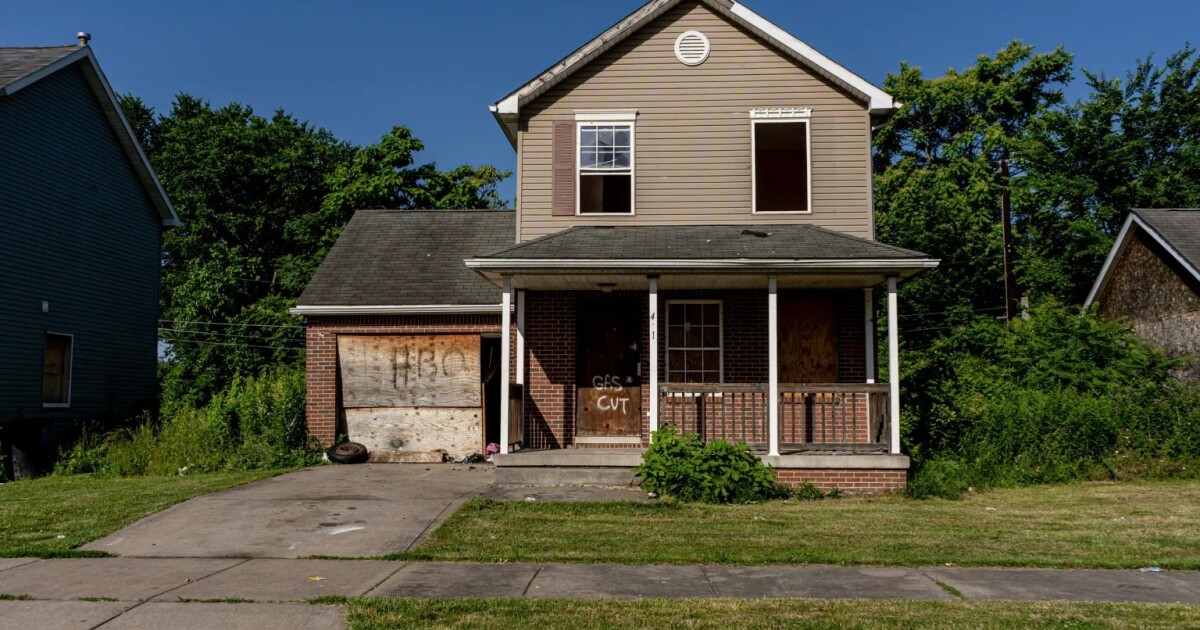
Starting in July 2023, a real estate startup based in Florida made an enticing offer to international investors: with just $50, anyone possessing a crypto wallet could invest in a portfolio encompassing 39 homes located on Detroit’s eastside. This initiative proved to be a significant success for RealT, a company specializing in “fractional ownership” of properties in cities including Detroit, Cleveland, and Chicago. Investors collectively contributed over $2.72 million for the property bundle—far exceeding the $1.1 million that RealT had agreed to pay for the homes, as per the seller’s agreement. However, the transaction never finalized. The deeds for these homes still show Brewer Park Homes LDHA LP as the owner, rather than RealT, even more than a year after the last shares, referred to as tokens, were purchased. It remains unclear if RealT has made investors aware that the sale did not proceed.
### Concerns About Ownership and Transparency
The founders of RealT, brothers Remy and Jean-Marc Jacobson, assert that they run the largest marketplace for real estate of its kind globally. Their business model involves purchasing properties, breaking them into thousands of digital tokens, and selling these tokens primarily to cryptocurrency investors, while U.S. residents are prohibited from participating. However, there are doubts regarding whether RealT’s investors fully grasp the nature of their acquisitions. Many may not have seen the over 650 tokenized properties scattered across various neighborhoods in Detroit.
RealT has also faced criticism for its lack of transparency, allegedly withholding or misrepresenting essential information. The company claims that its token holders are the legal owners of the properties. Yet, without deeds for the homes on the eastside or many others within its Detroit inventory, the validity of RealT’s ownership claims—and the underpinning value of the investors’ tokens—remains questionable. A lengthy investigation by Outlier Media has raised substantial concerns regarding RealT’s integrity and operational viability. The company has reportedly sold digital tokens for properties it does not legally own, misled investors about the conditions and occupancy status of these properties, and continues to distribute dividends for homes that have not generated rental income for extended periods, leading many—including tenants and real estate professionals—to suspect that the operation may be a fraudulent scheme masquerading as a technological innovation.
### Legal Action from the City of Detroit
In response to these issues, the City of Detroit has initiated legal proceedings, with Corporation Counsel Conrad Mallett declaring it “the largest nuisance abatement lawsuit” in the city’s history against RealT in Michigan’s 3rd Circuit Court. The lawsuit aims to compel RealT to ensure that its entire portfolio meets local building codes. The complaint notes that “the citizens of Detroit are paying the price in the form of their neighborhoods being inundated with dangerous structures that invite squatters and criminal activity.” Despite the numerous concerns raised, RealT continues to tokenize new properties almost weekly, having added 87 properties this year alone.
### Investor Dismay and Growing Concerns
A long-time investor in RealT expressed serious concerns in a message to Outlier, suggesting that the situation is approaching a model akin to a Ponzi scheme. Citing fears for their safety due to recent incidents involving violence against crypto investors, the individual provided evidence of their RealT token holdings but chose to remain anonymous. They indicated that if the allegations are accurate, the premise of investing in a Real World Asset is fundamentally flawed, prompting them to withdraw all their investments from RealT.
### Challenges in Detroit’s Real Estate Landscape
Detroit serves as the epicenter of RealT’s operations, with the company claiming to possess a greater real estate portfolio in the city than any other location. Currently, RealT manages around 1,600 rental units in Detroit. Prior investigations by Outlier Media revealed that the company owes the city millions in unpaid taxes and fines related to property violations, while tenants have been persistently demanding essential repairs. It appears that RealT has failed to submit property transfer affidavits for numerous properties, violating state law, and has also neglected paperwork for state-subsidized housing developments that are significantly overdue.
Industry experts have expressed alarm regarding RealT’s business practices. “You have absentee landlords that are not doing right by their tenants and not being held accountable,” remarked Mark Hays, a senior policy analyst with Americans for Financial Reform. “Additionally, the distributed ownership model introduces another layer of complexity, opacity, and lack of accountability that could either amplify existing abuses or complicate efforts to ensure accountability.”
### The Ownership Dilemma
According to an offering memorandum provided to investors, RealT signs a purchase agreement with property sellers before listing the property on its marketplace to raise funds. If sufficient tokens are sold, the deal is supposed to be finalized. However, this did not occur with the 39 homes located on Lillibridge and Fairview streets. RealT sold all available tokens to investors between July 2023 and March 2024, as verified by a third-party platform tracking RealT data, but the transaction never completed.
Current indications suggest that Brewer Park Homes LDHA LP remains the legal owner of the properties, holding the deeds, paying taxes, and receiving fines. Kathy Makino-Leipsitz, the listed owner for Brewer Park Homes, confirmed that RealT does not own the homes. “It’s been under purchase agreement for over a year but hasn’t closed,” she stated. Shaun Wilson, a spokesperson for RealT, attributed the delay to the seller’s failure to provide adequate documentation necessary for the company to complete the purchase. He noted that RealT has until May 2026 to make a final payment on the acquisition and has already remitted 80% of the agreed price, a claim disputed by Makino-Leipsitz.
### Tenant Experiences and Management Issues
Although Brewer Park Homes holds the title on paper, in practice, residents report that RealT has taken on the responsibility of managing the properties. Chiona White, a tenant in a Brewer Park home, stated she has spent $5,000 of her own money on repairs since moving in with her two children in late 2023. She noted the absence of a formal lease and claimed she has not received any maintenance from RealT. White expressed confusion over whom to pay rent to when RealT’s management company contacted her earlier this year, as they did not provide proof of ownership. In June, she received a notice to vacate, which is often a precursor to eviction, demanding she leave by July 8. “No one has come to do anything, fix anything,” White lamented. “I’ve spent my own money. I feel like I’ve done more than what they were supposed to do.”
### Persisting Issues with Property Titles
In a January interview, the Jacobsons attributed Detroit’s challenges to a local property manager. They subsequently filed a lawsuit against Shawn Reed, alleging misuse of funds and neglect in property renovations, to which Reed has responded by denying the claims. Nevertheless, even if the allegations against Reed were validated, they do not clarify the inconsistencies present in RealT’s narrative.
Outlier’s examination of 25 properties that RealT had offered to investors in January—long after severing ties with Reed and other property management firms—revealed that the same problems persist: 21 properties are behind on tax payments, and 14 are unoccupied, based on U.S. Postal Service data provided by Regrid. At the time of the offerings, RealT had indicated that 24 of these properties were occupied.
Records from the Wayne County Register of Deeds show that only three of these properties are actually owned by RealT, while the rest are associated with Coastal Line Homes LLC, which is linked to Erdem Sezer, a Turkish real estate investor. Efforts to contact Sezer for comment were unsuccessful.
### Questions Surrounding RealT’s Business Practices
RealT representatives have stated that “title issues” are impeding the transfer of property deeds, with assurances that a resolution is forthcoming, though they did not elaborate on the specifics of these issues. Investors have conveyed to Outlier that RealT does not provide purchase agreements detailing how much they pay for properties, allowing the company to inflate the market value of homes available on its investment platform.
Darin McLeskey, a real estate broker, expressed astonishment upon discovering that homes he sold in 2023 appeared on RealT’s marketplace at prices more than double what he had sold them for. McLeskey, who sold 45 homes to another investor for just over $20,000 each, noted that shortly after, those properties were transferred to LLCs associated with RealT and listed at around $55,000 each. “I have no clue how someone can justify paying that much,” McLeskey remarked.
The properties are part of Ephesus Homes, a low-income housing initiative. McLeskey emphasized that these homes “aren’t really designed to make money” due to rent caps for tenants. Yet, RealT has promised investors a 10% return, a claim that seems unrealistic given the circumstances. The company would need to generate rental income to pay dividends, at least in principle.
### Discrepancies in Vacancy Rates
RealT has claimed a 2% vacancy rate while marketing properties to potential investors. However, this figure contradicts data from the U.S. Postal Service, which indicates approximately 20% vacancy. Despite these discrepancies, RealT continues to distribute dividends nearly every week for most properties.
### Legal Demands from the City
The lawsuit filed by Detroit demands that RealT obtain compliance certificates for all 408 properties mentioned in the complaint, with a directive to repair the most severely dilapidated properties within a 90-day timeframe. The suit also seeks to hold the Jacobsons personally accountable for the costs associated with bringing the properties up to code.
RealT faces potential penalties for failing to submit property transfer affidavits for at least 300 tokenized properties, as reported by the city assessor’s office. These affidavits are crucial for notifying assessors of ownership changes and must be submitted within 45 days post-purchase. Real estate experts have noted that some buyers may bypass this requirement to evade higher taxes.
The state is also monitoring RealT closely. The company owns at least six low-income housing developments, which come with stringent compliance regulations, including annual inspections and reports overseen by the Michigan State Housing Development Authority (MSHDA). Outlier has acquired emails from MSHDA indicating that RealT is significantly behind on compliance for all six developments.
Katie Bach, MSHDA’s communications director, stated, “RealT is a relatively new owner, and we are working with them to get paperwork back into compliance. They have inherited issues and are actively working through them. We have provided an action plan to RealT, and they have agreed to it. If they do not meet the submission deadlines, they will receive a noncompliance letter, consistent with our policy.” A noncompliance letter could trigger a series of consequences, including fees, the recapture of tax credits from previous years, and potential legal action by the state’s attorney general.


